Fewer international students: what it could mean for your college chances
International applications to US colleges are falling. Here is which colleges may have more room for US applicants, which won't, and what to do about it.
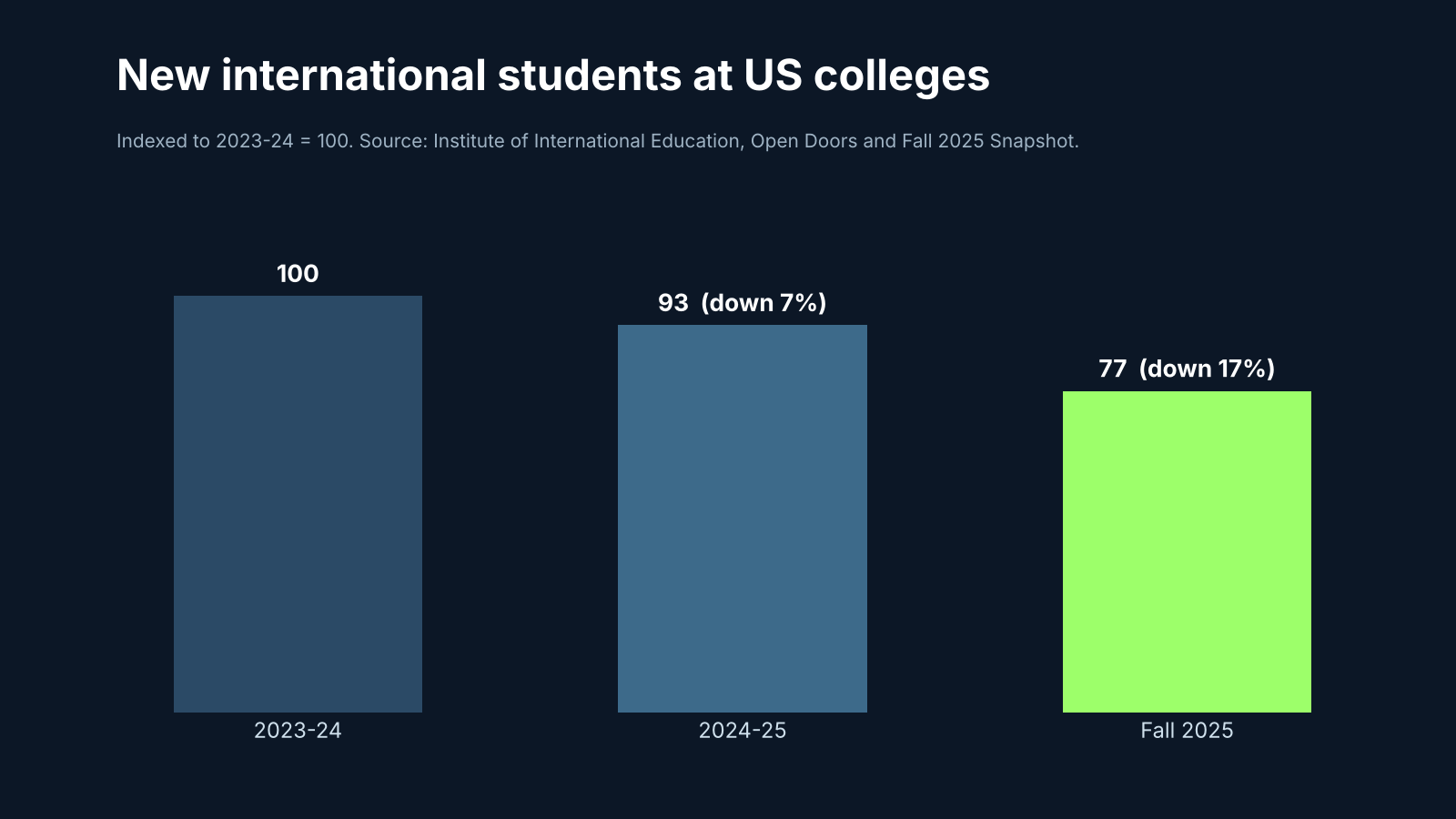
For years, US colleges enrolled more international students almost every year. That has turned. Federal visa and immigration changes, slower visa appointments and more competition from universities in other countries have all played a part, and the numbers are now falling at many colleges.
For a US family, the question is simple: does that change your chances? At some colleges, maybe. At many, hardly at all. Here is how to tell the difference.
What is happening
- Fewer new international students. The Institute of International Education's Open Doors figures show new international enrollment fell 7% in 2024-25, then 17% in fall 2025.
- Fewer applications. The Common App reports that applicants from outside the US fell about 10% in the 2025-26 season.
- More of the same this fall. NAFSA, the association for international educators, projects up to 111,000 fewer international students in 2026-27, about a 9.5% drop. In a survey of colleges published this week, 45% said their international undergraduate numbers fell this fall.
Most of the drop so far is among graduate students. Undergraduate numbers have held up better, but the trend is the same direction.
Why a college would care
International students usually pay the full price. That money helps many colleges pay for financial aid and scholarships for everyone else. When fewer international students arrive, a college has empty seats and less money, and the most direct way to fill both is to admit more students from the US.
Where it may make a difference
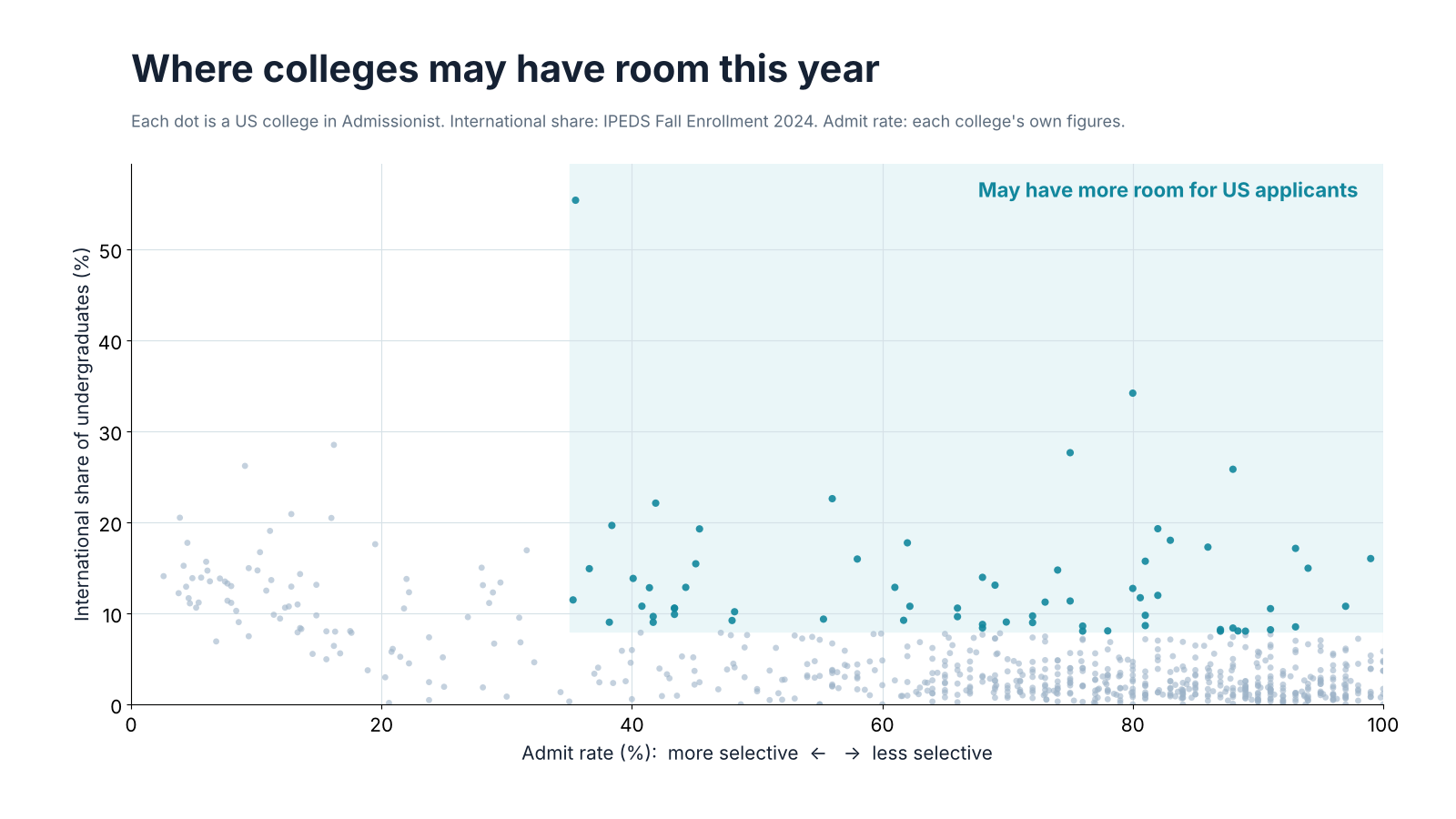
Not everywhere. A college that turns away nine out of ten applicants has a long line of qualified US students and can fill any gap without changing its standards. The effect is most likely at colleges that:
- have a large share of international undergraduates to replace;
- are less selective, so they were never turning away most applicants; and
- have smaller endowments, so they feel the loss of tuition quickly.
An Associated Press analysis found more than 100 US colleges where international students make up at least 20% of enrollment and the endowment is under $250,000 per student. Those colleges have the most reason to look harder at US applicants.
The catch for families who need aid
More room does not always mean more aid. A college that has lost full-paying international students may look especially hard for US students who can pay the full price. If you need financial aid, check each college's net price for your income, not just your chance of getting in.
What nobody knows yet
Colleges publish their admit rates the year after. The 2026-27 numbers will appear in each college's Common Data Set around spring 2027, and in federal data later still. So for this application cycle, a college's international share is an early sign, not proof that its admit rate is rising. Treat it as a reason to take a second look, not a promise.
What to do now
- Look at the international share of the colleges you are considering. In Admissionist, open a college and look under Admission, or add the International column in Colleges.
- Try the "May have more room this year" button in Colleges. It shows colleges where at least 8% of undergraduates are international and at least 35% of applicants are admitted.
- Keep your list balanced. A college that may have more room is a good candidate for a Target or a Safety, not a reason to drop your Reaches.
- Check the cost. Look at the net price for your family's income before you fall for a college.
- Apply on time. If a college does have more room, the earlier rounds are where it is easiest to show interest.
We will check this in spring 2027, when the new admit rates are published, and report back on whether the colleges with the most room really did admit more US students.
Sources
- Institute of International Education, Open Doors 2025 and the Fall 2025 Snapshot, as reported by the American Council on Education
- Common App End-of-Season Report, August 2026, as reported by The College Investor
- NAFSA and JB International projection, as reported by Forbes
- Fall 2026 survey of colleges, as reported by Higher Ed Dive
- Associated Press analysis of enrollment and endowments, as reported by the Los Angeles Times
- International share of undergraduates: IPEDS Fall Enrollment 2024, National Center for Education Statistics
Figures and rules change. Always confirm deadlines, requirements and costs on each college's own website.
See where you stand
Enter a GPA, a test score and your state to see your Reach, Target, Safety and Pass colleges.
Try it free